The Strange Economics of a Token
AI tokens are getting dramatically cheaper. So why do AI bills keep rising? This explainer unpacks the economics of token pricing, reasoning models, agents, and flat-rate subscriptions, and explains why cost per task matters more than price per token.

TLDR
Every AI product you use is metered in tokens, the word fragments models read and write. Token prices are collapsing at roughly ten times per year, yet AI bills keep rising, total consumption is exploding, and flat-rate subscription businesses keep discovering their heaviest users are unprofitable. Understanding why explains most of the strange pricing behavior in AI, and it comes down to one formula. Cost per task equals tokens per task times price per token, and the two halves are moving in opposite directions.
What exactly are you paying for?
A token is a chunk of text, roughly three-quarters of an English word. When you send a model a question, it reads your input as tokens and generates its answer as tokens, and the meter runs on both. As of this summer, OpenAI's flagship charges $2.50 per million input tokens and $15 per million output tokens. Anthropic's top model runs $5 and $25. Google's is $2 and $12.
Notice the asymmetry. Output costs five or six times more than input, and the reason is physics rather than marketing. A model reads your entire prompt in one parallel pass, but it writes its answer one token at a time, each new word requiring a full trip through the model. Reading is wholesale. Writing is retail. This is why verbose outputs cost real money and why prompt design that produces short answers is a finance decision, not a style preference.
If prices are collapsing, why is my bill going up?
The deflation is real and historic. Andreessen Horowitz measured the cost of a fixed level of model quality falling about ten times per year, with GPT-3-class intelligence dropping a thousandfold in three years. Stanford's AI Index found the price of querying a GPT-3.5-level model fell more than 280-fold in about 18 months. Nothing in mainstream computing history has deflated this fast.
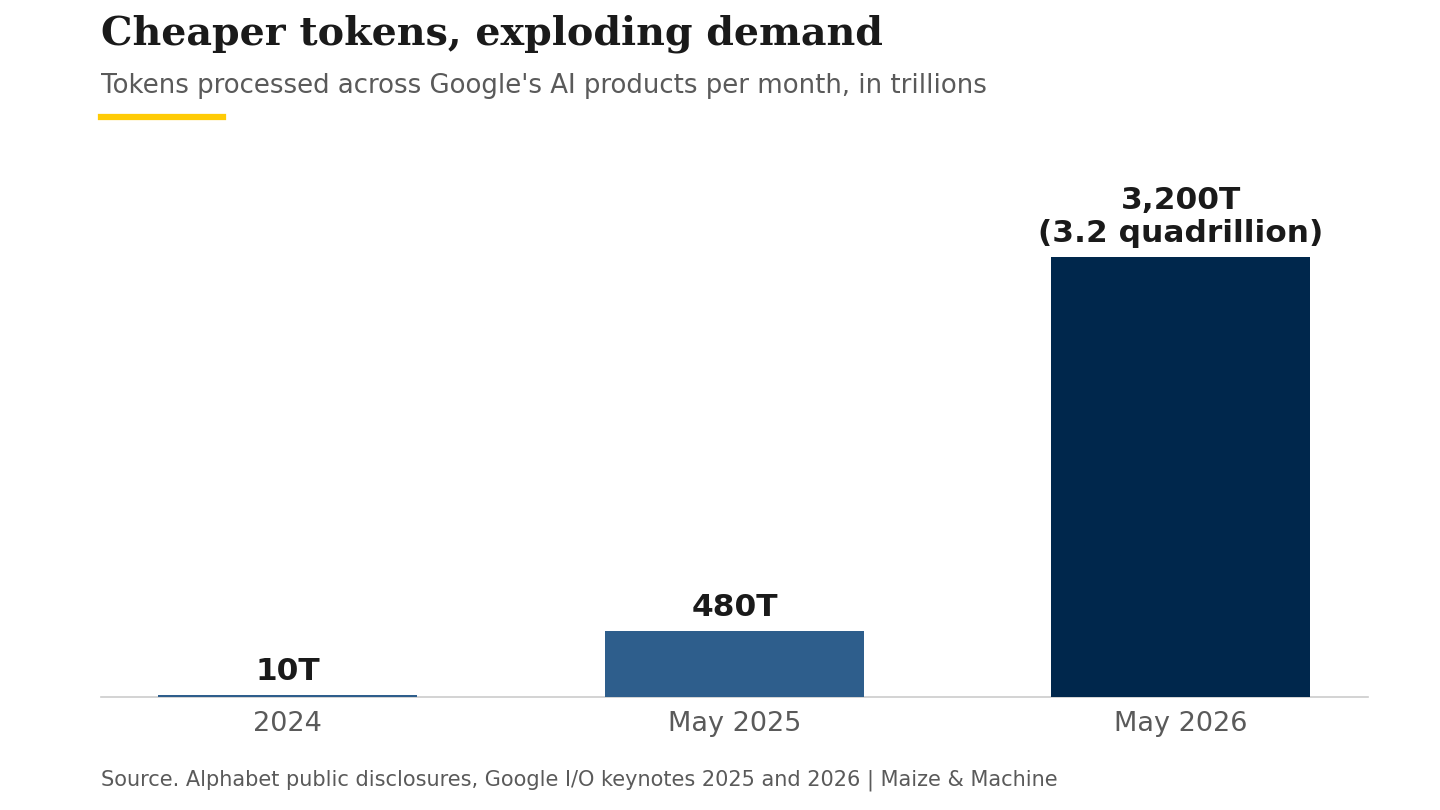
And yet total spending climbs, because consumption is outrunning the deflation. Google processed 9.7 trillion tokens a month in 2024. By May 2026 it reported 3.2 quadrillion, a three-hundredfold increase in two years. OpenRouter, a marketplace routing traffic across models, hit 25 trillion tokens a week, five times its volume six months earlier. Cheaper intelligence does not shrink the market. Cheaper intelligence finds new work, the same pattern economists observed when efficient steam engines increased coal consumption rather than reducing it.
Three multipliers do most of the work. Reasoning models think before answering, and the thinking is billed. One benchmark found a reasoning model generated eight times the tokens of its conventional sibling, turning a $109 evaluation into a $2,767 one. Long context costs extra on top of that. Google doubles its input price beyond 200,000 tokens of context, because serving long prompts hogs expensive memory. And agents multiply everything, since a single request now fans out into dozens of model calls, searches, and tool uses, each metered. The task got cheaper per token while the token count per task exploded.
Why do subscription plans keep breaking?
Flat-rate pricing meets metered costs, and the collision is public. Cursor, the AI coding tool, moved its $20 plan from effectively unlimited to compute-based credits and then apologized for the chaos, because heavy users of frontier models were unprofitable at any reasonable subscription price. Anthropic added weekly rate limits after a small share of subscribers ran its coding agent around the clock. The arithmetic is unforgiving. When your best customer's marginal cost exceeds his subscription, every power user is a small subsidy program.
Expect the pattern to keep spreading. Usage-based pricing, credit systems, and throttles are not vendor greed. They are what happens when a business with newspaper-style pricing discovers it has an electricity-style cost structure.
What does this mean if you are building the business case?
Inference, the cost of running models rather than training them, is becoming the dominant AI expense, with estimates putting it at half of all AI compute in 2025 and rising toward two-thirds. Enterprise budgets are following. One survey of a hundred CIOs found LLM budgets expected to grow about 75 percent in a year, with one of them admitting that what he spent in all of 2023 he now spends in a week.
For anyone modeling an AI product or deployment, four levers matter more than the headline price. Match the model to the task, since routing routine work to a small model costs one-twentieth of sending everything to the flagship. Control output length, because the expensive tokens are the ones the model writes. Cache and batch, as providers sell batch processing at half price for anything that can wait. And model your costs at success-level volume, because the pilot bill is never the production bill, and the difference has killed more AI budgets than any model failure.
Who wins and who gets squeezed?
The strategic map follows from the cost structure. The model providers are running a price war at the frontier while making margin on volume, scale being the only durable advantage when your product deflates tenfold a year. The application companies in the middle face the classic reseller's squeeze. They buy tokens wholesale and sell workflow retail, and their fate depends on whether the workflow adds enough value to survive both the providers moving up into applications and the customers realizing they could buy the tokens directly. The Cursor episode was this squeeze arriving on schedule.
For everyone else, the buyers, the falling curve is quietly the best news in enterprise technology. A use case that pencils out badly today pencils out well in eighteen months without anyone lifting a finger, which means the right response to an unaffordable AI business case is often not no but a dated calendar reminder. The companies that keep a shelf of almost-viable use cases, repriced quarterly, will beat the ones that evaluated once and moved on.
A worked example makes the arithmetic concrete. Suppose an internal research assistant averages 3,000 input tokens and 1,000 output tokens per query on a flagship model. At current flagship prices that is roughly two cents a query, invisible at a hundred queries a day and a $70,000 line item at a million a month. Route two-thirds of those queries to a small model and cap output length, and the same workload costs a fraction as much with no change users notice. That one afternoon of routing work is what token literacy is worth.
Final Assessment
Token economics reward a specific kind of discipline. Unit costs are falling fast enough to make almost any use case viable eventually, while consumption grows fast enough to punish anyone who treats AI as a fixed cost. Build the business case on cost per task, watch the tokens per task as closely as the price per token, and be suspicious of any plan, your vendor's or your own, that promises unlimited intelligence for a flat fee. The market keeps proving that promise expensive.
Prices are as published in August 2026 and change frequently. Sources linked inline.
Srini Simhan is a graduate student at the University of Michigan's Ross School of Business and the VP of Content and Editor-in-Chief of Maize & Machine, the publication of the AI & Emerging Technology Club. He works as a Forward Deployed Product Manager in FinTech with a background in software engineering and machine learning, and outside of work he leads a nonprofit and advises early-stage founders on building with AI.