What Klarna Learned Firsthand
Klarna went all-in on AI customer service, cut costs, and let its workforce shrink, and then admitted quality had suffered. Its retreat was not a failure of AI, but a lesson in where automation ends and human service becomes the premium.
TLDR
Klarna automated customer service harder and earlier than any major consumer company, announced its AI was doing the work of 700 agents, shrank its workforce by nearly half through attrition, then publicly admitted the cost focus had damaged quality and began rehiring humans for the work that matters most. The retreat was not a failure of the AI. It was a correction of the strategy around it, and the settled model Klarna landed on, machines for the routine and humans as the premium, is the most instructive case study in enterprise AI. Every figure in it comes from Klarna itself, which is part of the lesson.
What did Klarna actually do?
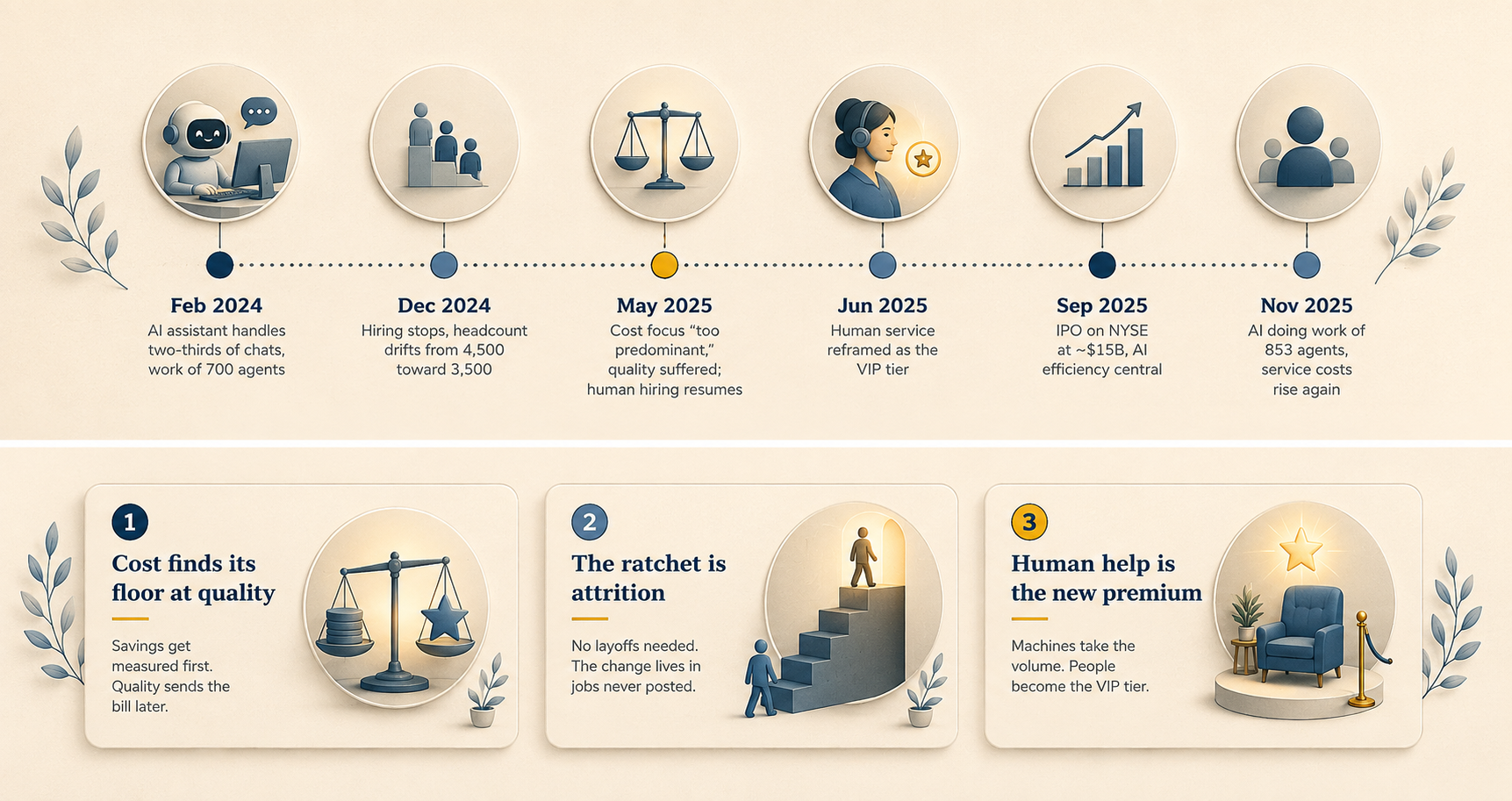
In February 2024, the Swedish payments company made the boldest AI claim any large consumer business had put in a press release. Its OpenAI-powered assistant had handled 2.3 million customer service conversations in its first month, two-thirds of the total, doing the work of 700 full-time agents with resolution times down from eleven minutes to under two, and a projected $40 million profit improvement. OpenAI showcased the numbers, and Klarna's chief executive, Sebastian Siemiatkowski, became the loudest voice in tech on AI replacing jobs. By December 2024 he was telling Bloomberg the company had stopped hiring entirely, letting attrition carry headcount from 4,500 toward 3,500, and by mid-2025 he put the reduction at about 40 percent.
One clarification the coverage usually mangles. Klarna's 700-person layoff in 2022 predated the AI assistant and was a cost decision. The AI-era reduction came through a hiring freeze and normal turnover. The machine never fired anyone. It made not replacing people feel safe.
Why did the loudest AI optimist blink?
In May 2025, Siemiatkowski said something chief executives almost never say on the record. Cost had been too predominant a factor, and the result was lower quality. Klarna began recruiting human agents again, building an Uber-style pool of flexible remote workers, and promising customers a human would always be reachable. By June he had found the framing he liked. Human customer service would become a VIP offering, the way hand-stitched clothing signals luxury in a world of machine production.
Read the sequence carefully, because it is subtler than the headlines on either side. Klarna did not unplug the AI. The assistant kept handling roughly two-thirds of inquiries throughout, and by late 2025 the company said it was doing the work of 853 full-time agents with some $60 million in cumulative savings. What reversed was the ambition to make automation total. Customer service and operations spending actually rose, from $42 million to $50 million year over year in the third quarter of 2025, because the company was paying for quality it had automated away.
What does the episode actually prove?
Klarna is a Rorschach test. AI boosters see vindication, an assistant absorbing two-thirds of support forever. Skeptics see a cautionary tale, a company forced to rehire the humans it bragged about replacing. The evidence supports something more precise, in three lessons.
Cost-led automation finds its floor at quality. Automating to save money works until customers meet the edge cases, and edge cases are where loyalty is won or lost. Klarna's correction came from its own quality signals, not from the technology failing. Compare Commonwealth Bank of Australia, which cut 45 call-center jobs on the promise of a voice bot, watched call volumes not fall, and reversed the redundancies while admitting error. The pattern is general. Automation announced as savings gets measured in savings, and quality sends the bill later.
The ratchet works through attrition, not layoffs. Klarna's workforce fell from a peak above 7,000 to around 3,000 without an AI-attributed layoff, and revenue per employee climbed from $300,000 toward $1.3 million. This is what AI-driven workforce change mostly looks like, quiet, gradual, and visible only in the jobs that never get posted. Salesforce offers the louder version, its support organization shrinking from 9,000 toward 5,000 as its agents took over conversations.
Human attention is repricing as a premium. The stable equilibrium Klarna found puts machines on volume and humans on the differentiated tier, which inverts a century of service economics in which human help was the default and automation the upgrade. Siemiatkowski's hand-stitching analogy is glib, and it is also probably right. When the routine is free, the human is the luxury.
Why did the story travel so far beyond Klarna?
Because Siemiatkowski made himself the industry's designated truth-teller, and the role has consequences. While peer executives hedged, he said the quiet part repeatedly, that AI could do most of the jobs, that his workforce had halved, and later that fellow chief executives were sugarcoating what is coming for knowledge work. That candor made Klarna the reference case in every boardroom debate about service automation, which was excellent marketing during the AI-forward years and became a liability precisely when the quality problems surfaced in public view.
The company was also not a neutral narrator at any point. It was preparing to go public through the entire arc, and an AI-efficiency story that moved revenue per employee from $300,000 toward $1.3 million was worth real money in the offering. None of that makes the operational facts false. It makes them curated, and a careful reader holds both thoughts at once.
What should a reader do with this?
Treat every number here with the appropriate discount, because all of it, the 700 agents, the satisfaction scores, the $60 million, comes from Klarna's own disclosures, unaudited, from a company that went public in September 2025 with AI efficiency as a core part of its story. The case is instructive precisely because the incentives are visible.
Then steal the framework. Automate the routine and measure it honestly. Protect the relationship work, and decide before the rollout which work that is. Watch quality metrics with the same attention as cost metrics, because the second will always look better first. And when the correction comes, make it publicly, since Klarna's candor about overshooting has bought it more credibility than the original boast ever did.
Final assessment
Klarna went first, overshot, corrected in public, and landed on the model most companies will eventually adopt. The company's real contribution is a complete, dated, public record of what total automation costs, where its floor sits, and what the durable division of labor looks like. Going first is expensive. Reading the case of the company that did is free.
All operational figures are Klarna's own disclosures, unaudited. Sources linked inline.
Srini Simhan is a graduate student at the University of Michigan's Ross School of Business and the VP of Content and Editor-in-Chief of Maize & Machine, the publication of the AI & Emerging Technology Club. He works as a Forward Deployed Product Manager in FinTech with a background in software engineering and machine learning, and outside of work he leads a nonprofit and advises early-stage founders on building with AI.